



Edelmetalle recyceln und analysieren
Die weltweite Nachfrage nach Edelmetallen nimmt weiter zu, sowohl für die Schmuckherstellung als auch für industrielle Anwendungen. Während die Verwendung von Gold und Silber für Schmuck Jahrtausende zurückgeht, ist die Nutzung für industrielle Zwecke in den Bereichen Chemie, Elektronik, Luftfahrt und Fahrzeugbau noch relativ neu. CARBOLITE Öfen werden weltweit sowohl für das Recycling dieser seltenen Rohstoffe eingesetzt als auch zur Bestimmung der Reinheit. Die wichtigsten Verfahren sind das Schmelzen und das Kupellieren.
Entbindern und Sintern von keramischen Schäumen
Das Fraunhofer Institut für Keramische Technologien und Systeme (IKTS) in Dresden deckt das Feld der Technischen Keramik von der grundlagenorientierten Vorlaufforschung bis zur Anwendung in seiner ganzen Breite ab. Die Kernkompetenz liegt in der Entwicklung neuer bzw. modifizierter keramischer Werkstoffe und Cermets (Keramik-Metall- Verbundwerkstoffe) unter Nutzung sowie Generierung neuester Technologien.
Höchste Qualität bei Additiver Fertigung ermöglichen
Die Additive Fertigung wie auch das Pulverspritzgießen bieten großes Potential, wenn die eingesetzten Materialien von optimaler Qualität sind. Aber auch der Prozess muss kontinuierlich überwacht und die fertigen Bauteile müssen sorgfältig geprüft werden, um so die relevanten Kenngrößen für eine qualitativ hochwertige, kosteneffiziente Produktion zu ermitteln. Die in diesem Beitrag genannten Unternehmen der Verder Scientific Division bieten hierfür zuverlässige und kundenfreundliche Lösungen an.
Kondensationsfreies Entbindern mit Vakuumöfen
Verfahren wie Rapid Prototyping, Pulvermetallurgie, Silizieren und Sintern werden zur Herstellung unterschiedlichster Produkte eingesetzt. Das Sintern ist zum Beispiel der letzte Schritt in einem “Near-Net-Shape” Produktionsprozess. Viele Herstellungsverfahren, wie z. B. das Metal Injection Molding (MIM), erfordern vor dem Sintern eine Entbinderung.
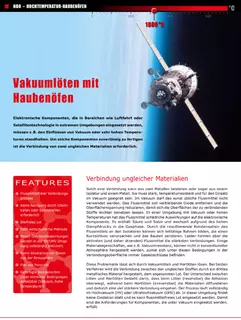
Vakuumlöten mit Haubenöfen
Elektronische Komponenten, die in Bereichen wie Luftfahrt oder Satellitentechnologie in extremen Umgebungen eingesetzt werden, müssen z. B. den Einflüssen von Vakuum oder sehr hohen Temperaturen standhalten. Um solche Komponenten zuverlässig zu fertigen ist die Verbindung von zwei ungleichen Materialien erforderlich.
Wärmebehandlung bei niedrigen Drücken
Hochtemperatur Vakuumöfen erlauben die Wärmebehandlung von Proben bei niedrigen Drücken (bis 10-6 mbar) sowie unter speziell einstellbaren Partialgasatmosphären. Beim Konzept „Bottom Loader“ wird der Boden zum Beschicken abgesenkt und aus dem Ofen herausgefahren. Danach kann der Boden nach vorne geschwenkt werden. Das erleichtert die Beschickung, da das Nutzvolumen von allen Seiten zugänglich ist. Außerdem können beispielsweise Probenthermoelemente punktgenau platziert werden.
Wärmebehandlung von Bauteilen aus Pulverspritzguss & Additiver Fertigung
CARBOLITE GERO bietet passende Öfen für die verschiedenen Prozessschritte im Pulverspritzgussverfahren (PIM) und in der Additiven Fertigung (AM) von Metall- oder Keramikteilen an. Dazu zählen z. B. das thermische oder katalytische Entbindern, das Trocknen von Teilen, z. B. nach der Lösemittelentbinderung, das Spannungsarmglühen sowie das Sintern unter Schutzgas, Wasserstoff oder Vakuum
Cement Testing for Compliance
The compliance of cement with standards such as EN 197 / ASTM C 150 is a quality requirement. Quality assurance of the raw materials used in calcination and also during the clinker production is necessary. Carbolite Gero offers different furnaces that help to guarantee quality requirements are met during the production cycle.
Challenges and solutions in high vacuum soldering and brazing
Nowadays, numerous electronic components, such as those employed in satellites or aircraft, must endure harsh conditions, including vacuum or elevated temperatures. The fabrication of these electronic omponents necessitates the bonding of heterogeneous materials.
Comparison between graphite and metallic lined MIM furnaces
This study reports on the parts quality and on the energy and resource consumption for both kinds of furnace for a typical batch type production process. The primary outcome achieved through the utilization of metallic lined Metal Injection Molding (MIM) furnaces is that highest densities of 7.9 g/cm^3 are achieved when using Hydrogen and a significant reduction in carbon content by 50 %. This advancement, however, is accompanied by a 30 % increase in the product's carbon footprint.
Continuous Strand Hardening and Tempering Furnace
The split furnace processes two strands simultaneously through a pair of tubes side by side, at up to 15 metres/minute while ensuring the combination of hardness, temper, ductility, and flatness required by the customer.
Determining the CO2 reactivity of petroleum coke
Calcinated petcoke is an essential ingredient in the production of aluminium. Its quality needs to be monitored continuously throughout the production process to ensure a high quality metal grade. As part of its range of coke testing furnaces, Carbolite has designed a special model for determining the CO2 reactivity of petroleum coke in accordance with ISO 12981-1. The furnace has a single, vertical, tubular heating zone which is integrated into the unit, giving a neat and compact design overall.
Graphitisation at up to 3000 °C - What is it good for?
Graphite is a soft, slippery, greyish-black substance. It has a metallic luster and is opaque to light. Graphite is a good conductor of heat and electricity. Often graphite is simply named carbon. Under inert gas or vacuum graphite is extremely temperature-resistant which makes it an interesting material for high temperature applications.
Heat Treating 3D Additive Manufactured Parts
At present, there are two main techniques used in the additive manufacturing of 3D metal parts, Electron Beam Manufacturing (EBM) and Direct Metal Laser Sintering (DMLS). These take time but are outstanding for creating complex or ‘impossible’ parts which cannot be created using traditional casting or machining methodologies. This has already resulted in the creation of a multitude of prototype pieces as well as countless ‘impossible parts’ for the aerospace, automotive, tooling and medical sectors.
Heat Treatment of Steel
The HRF furnace is suitable for hardening and tempering steel by increasing the mechanical resistance through heat treatment. Powerful recirculating air turbines ensure excellent temperature homogeneity for optimum heat distribution, thus complying with requirements according to AMS 2750E Nadcap.
Heat Treatment Solutions for Innovative Battery Components
In the realm of battery manufacturing, the quality of materials and the precision of production processes play a pivotal role in determining the efficiency and longevity of the final product. High-quality materials ensure that the batteries can store and deliver energy reliably, while meticulous production processes guarantee consistency and safety.
Heat Treatment Solutions for Metal Injection Molding
The Metal Injection Molding (MIM) process is a widely known and applied technology for producing small metal parts. A great variety of materials and, consequently, approaches have been developed. The MIM process always requires a combination of polymer and metal powder. The polymer in this mixture has two purposes. On the one hand, it serves the rheological properties that are needed for injection molding. On the other hand, it provides the mechanical stability of the so-called green parts. The metal powder itself has no mechanical stability at all in that stage of the process.
High Temperature Furnace for Heat Treatment of Superconducting Magnets at CERN
The high temperature furnace GLO 10 000 KE/09-1G from CARBOLITE GERO is tailored for the heat treatment of superconducting coils for CERN. The plant, which is going into full operation at the CERN site in the middle of this year, was introduced in detail to the technical press on 18 March 2016 by CARBOLITE GERO at its premises in Neuhausen.
How coke is created in a coal testing oven or pilot plant
Thanks to huge advances in metallurgy over the last three decades, 21st century steel production is transforming the globe and the built environment. Of course, a major part of the steel production process is the use of coke, which provides as much as 80% of the furnace's thermal requirements, the majority of the furnace's CO gas (which acts as a reducing reagent) and carbon for dissolution in the molten metal. As with any other manufacturing process, the quality of the raw material has a massive impact on the quality of the end product. It is therefore vital to ensure the coke is comprehensively tested.
Modern Solutions for Safe Debinding of Ceramic Parts
CARBOLITE GERO has developed sophisticated safety concepts for safe debinding of ceramic parts